Introduction:
During Cultivating wellbeing sessions provided to staff in 2019, participants were asked to fill in a questionnaire and answers were collected and analyzed. The questionnaire includes Utrecht-3 for work engagement assessment, DSM-5 Self-Rated Level 1 Cross-Cutting Symptom Measure—Adult to screen for anhedonia and low mood (combined for depression) and for anxiety.
Sampling:
Attendants of the activities from different agencies participated, therefore the sample is that of convenience.
Randomization is not optimized. The bias of people having some emotional difficulties to participate more than others cannot be ruled out.
But usually people attend depending on finding some free time in their schedules, which is in favor of less biased participation.
Anyhow, the sample cannot be claimed to be properly randomized.
Sample Population:
The total number of participants was 117 ;76 Males and 41 females; coming from 8 agencies
Mean age of participants ~ 36 years.
Distribution by Agency was as follows:
|
FAO |
IOM |
OHCHR |
UNDP |
UNFPA |
UNHCR |
UNOPS |
UNWOMEN |
|
12 |
27 |
20 |
11 |
9 |
19 |
16 |
3 |
Analysis:
Analysis was done by R version 4.0.0 (2020-04-24).Student’s T test and regression analysis were used to make inferential statistical results.
Work Engagement:
Work Engagement among local UN Staff was found to be high.The mean was 13.65 (Maximum possible is 18, Minimum possible is 0). 75% of staff scored 12 or higher.
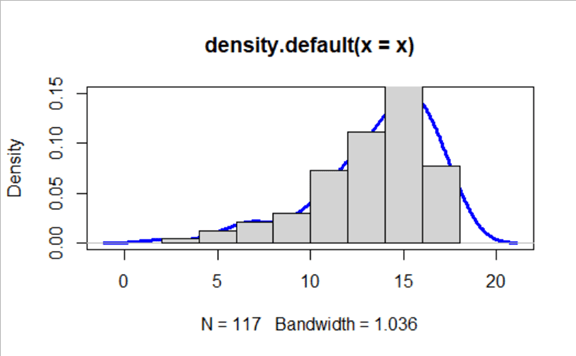
| Min | 1st Qu. | Median | Mean | 3rd Qu. | Max |
| 2 | 12 | 14 | 13.65 | 16 | 18 |
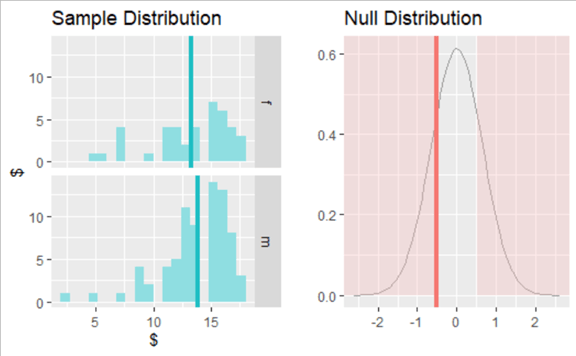
There was no statistically-significant difference between males and females ( p- value = 0.44 , confidence interval = -1.8109515 – 0.7872031 , T = -0.7858)
Work engagement was not correlated with age ( p-value: 0.49 , adjusted R-squared: -0.005 , F-statistic: 0.491)
Work engagement was negatively correlated with anhedonia.One unit increase in anhedonia score decreases work engagement by 0.9978 (p-value: 6.467e-05, Adjusted R-squared: 0.1225 , F-statistic: 17.2 on 1 and 115 DF)
Work engagement was also negatively correlated with experiencing low mood.One unit increase in low mood score decreases work engagement by 0.5595.
(Adjusted R-squared: 0.03701, F-statistic: 5.458 on 1 and 115 DF, p-value: 0.02121)
It was also negatively correlated with anxiety score.One unit increase in anxiety score decreases work engagement by 0.5739.
(Adjusted R-squared: 0.03297, F-statistic: 4.955 on 1 and 115 DF, p-value: 0.02797)
Finally , work engagement was independent of agency. There was no difference according to agency (p-value = 0.22)
Anhedonia:
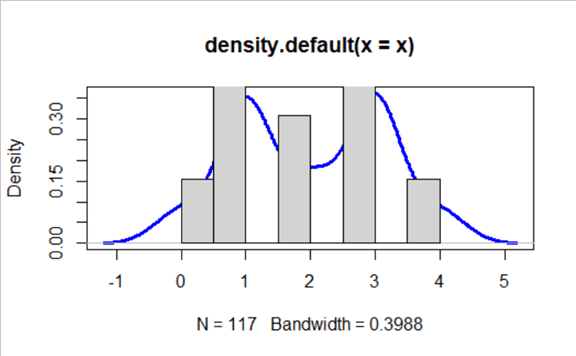
Anhedonia is measured by the extent of decrease of interest and inability to Experience pleasure/joy.A significant proportion of staff members scored at or above the cutoff point to warrant more evaluation by DSM5 measure : LEVEL 2—Depression—Adult or Clinical assessment.
| Min | 1st Qu. | Median | Mean | 3rd Qu. | Max |
| 0 | 1 | 2 | 2.009 | 3 | 4 |
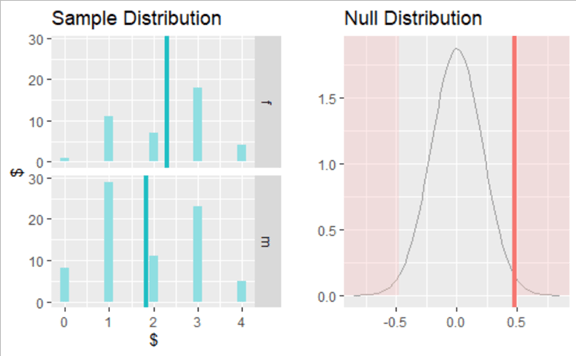
Females were more anhedonic than Males. The difference between gender was statistically significant.
(t-value : 2.2321 , p-value = 0.03 , 95% confidence interval = [0.05217573 , 0.89776009] , cohen’s d = 0.43)
Anhedonia was not correlated with agency (p-value = 0.47) or with age (p-value = 0.24)
Low mood:
A significant of staff members scored on low mood at or above the cutoff point to warrant more evaluation by DSM5 measure : LEVEL 2—Depression—Adult or Clinical assessment.
| Min | 1st Qu. | Median | Mean | 3rd Qu. | Max |
| 0 | 1 | 2 | 1.932 | 3 | 4 |
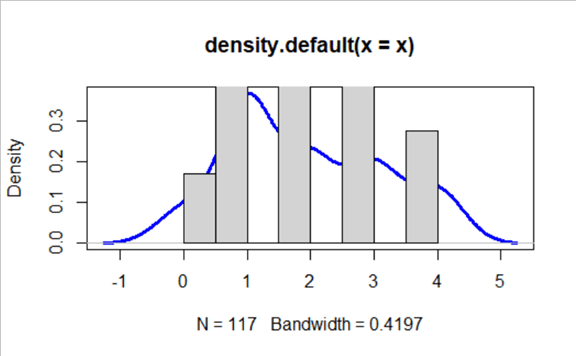
Females were experiencing low mood more than males.
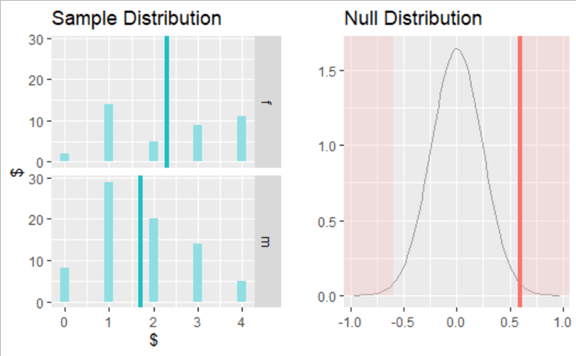
The difference according to gender was statistically significant.
(t-value: 2.4457, p-value: 0.019, 95% confidence interval : [0.1094099, 1.0773680], cohen’s d: 0.47)
Low mood was not correlated with agency (p-value = 0.14) but was correlated with younger age (p-value : 0.03)
Anxiety:
A significant proportion of staff members scored on anxiety at or above the cutoff point to warrant more evaluation by DSM5 measure : LEVEL 2—Anxiety—Adult or Clinical assessment.
| Min | 1st Qu. | Median | Mean | 3rd Qu. | Max |
| 0 | 1 | 2 | 2.043 | 3 | 4 |
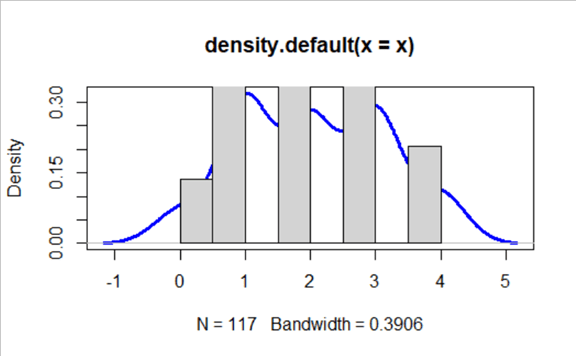
The difference between males and females was not significant (p-value = 0.11)
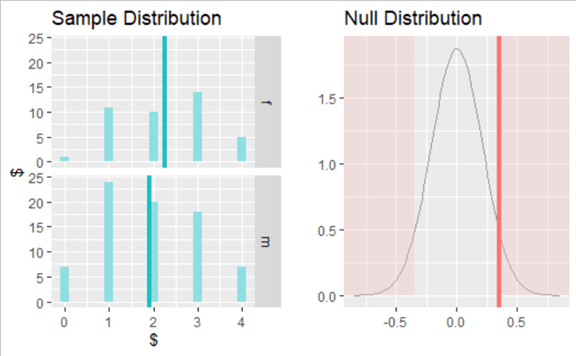
Anxiety score was correlated negatively with age, decreasing in older individuals (p-value : 0.004)
There was no significant difference between agencies (p-value : 0.06)
Note:
The study documents, raw data, and processed data are kept with the Staff Counseling – Yemen.
 Wellbeing Arena